
Explore late October 2026 coloring news, from Halloween coloring challenges and cozy trends to library groups and cultural coloring activities.
Late October 2026 offered a reminder that coloring can be many things at once: a quiet creative routine, an invitation into an illustrated story, and a way for people to spend time together.
Seasonal coloring challenges invited adults to share their work, libraries offered low-pressure creative activities, and a university linked coloring with cultural learning.
This roundup focuses on U.S.-relevant coloring contests and programs between October 16 and October 31, as well as a market snapshot dated October 23.
Dates and claims are taken from publishers, organizers, and clearly identified industry sources.
When a source announces an event rather than reports its outcome, we do not assume an attendance figure or level of success.
01 Introduction: Coloring Beyond the Page
A coloring page can be enjoyed on its own, but it can also be a starting point.
An illustrated scene may suggest a story.
A local workshop can encourage someone to try a new technique.
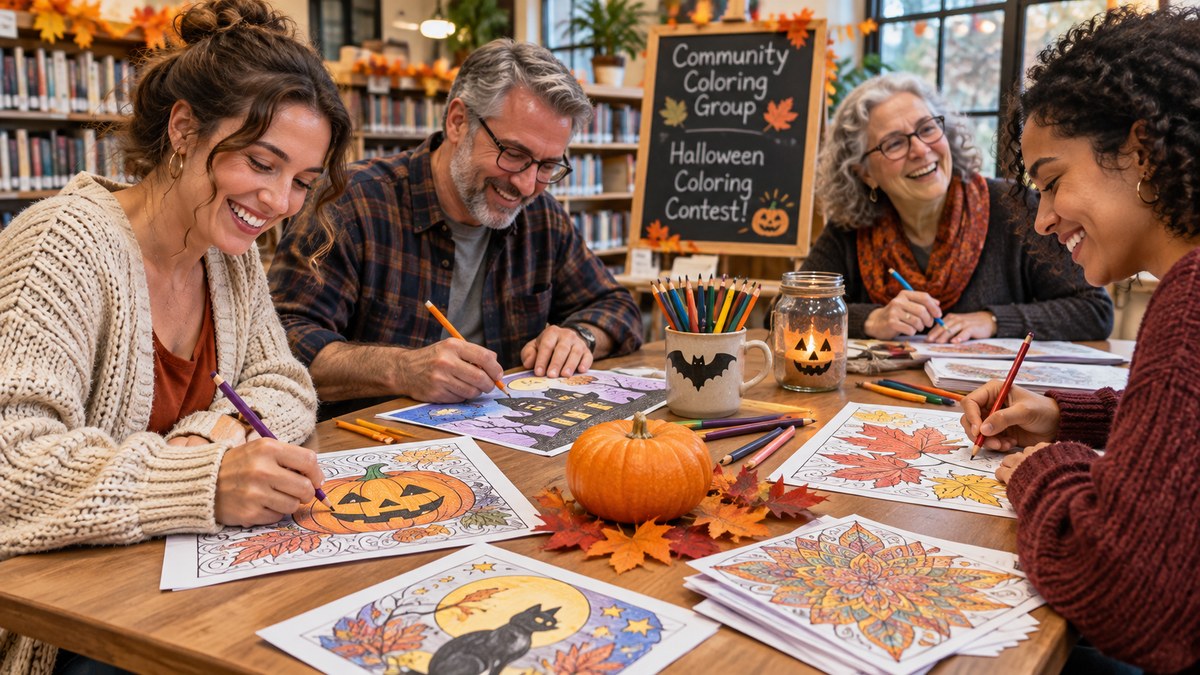
A shared table at a library can turn an individual pastime into a casual social activity.
For readers planning home projects, classrooms, or printable products, the practical lesson is simple: the experience around a page matters as much as the subject on it.
Accessible outlines, a clear visual focus, and a welcoming activity format can make it easier for beginners to participate.
02 Halloween Coloring Goes Social: Special Art's October Challenge
Special Art Books ran the Special Art Halloween Contest from October 18 to October 31, 2026.
Adults were invited to color eligible Halloween pages and share their finished work on Instagram, TikTok or the organizer's Facebook group, using the official entry instructions.
The organizer provided six free coloring pages, while owners of selected Special Art Halloween coloring books could also use eligible pages from those books.
The contest rules specified that participants must be 18 or older.
Colorists could explore different styles, from bright orange and purple to subdued greens and dramatic contrasts.
The event illustrates how a seasonal coloring theme can turn a quiet activity into a conversation about palettes, techniques and personal interpretation.
It is one example of community engagement, rather than evidence of a wider participation trend.
A Creative Idea to Try
Color an original Halloween design in two contrasting palettes.
Compare a cheerful palette with a spooky one, and discuss the different moods with friends or in an adult coloring group.
Respect the ownership of other creators' artwork.
03 The October 23 Market Snapshot Highlights Different Cozy Niches
ColorBliss published an October 2026 coloring-book trend report based on a snapshot captured on October 23.
The report examines selected Amazon U.S. categories, comparing titles, creator credits, formats, and prices.
Its analysis identifies a distinction between cozy-themed books in selected children's and adult fashion listings.
For example, among titles matching specified cozy-related terms in the categories reviewed, the report credits Coco Wyo on 13 of 15 matching children's titles and 3 of 24 matching adult fashion titles.
These are observations from particular lists at a particular point in time—not market-wide sales shares or evidence that every cozy category behaves the same way.
The important lesson for authors and coloring-page creators is to research the audience and shelf separately.
A warm, beginner-friendly visual style may work for multiple audiences, but the subject, level of detail, and page format should match the people who will use it.
A Practical Format Check
Before designing a new page collection, ask three questions.
Is the audience looking for quick, simple coloring or a longer detailed project? Will the pages mainly be used with pencils, crayons, or markers? And should a book feel like one connected world or a set of independent designs? Answering those questions is more useful than copying a popular title or character.
04 Adult Coloring Remains Part of Library Programming
The Pinellas Public Library Cooperative in Florida provides information about an Adult Coloring Group.
This illustrates how coloring can be organized as a community activity.
The currently available information does not establish that a session took place on October 28, 2026, or confirm any attendance figures.
Library coloring gatherings can be approachable because participants do not necessarily need expensive equipment or specialist training.
People may bring different levels of experience to the same table.
A simple flower, garden, or home-interior page can give everyone a recognizable starting point, while leaving room for personal choices.
For community organizers, a good session benefits from a few options: an easy page with broad coloring areas, a more intricate alternative, and enough time for participants to talk or work quietly.
Sharing supplies can be helpful, although individual access and venue rules should always be considered.
05 Ohio State's Day of the Dead Coloring Contest Connects Art and Culture
The Ohio State University Center for Latin American Studies promoted its 2026 Brutus Calavera Coloring Contest, with an October 30, 2026 submission deadline.
The program introduces the traditions of *Día de los Muertos* (Day of the Dead) and encourages participants to explore connections with Latin American and Latinx culture.
The contest welcomed children, teenagers and adults in five age categories, including ages 18 and above.
Eligible media included crayons, colored pencils, markers and paint.
The rules prohibited AI-generated submissions and pasted-on decorations.
Entries were judged for visual impact, creativity, interpretation, organization and craftsmanship.
This example shows how coloring can become a starting point for cultural learning.
Rather than focusing only on filling empty outlines, participants can learn about the meanings of motifs, colors and traditions associated with Día de los Muertos.
A Cultural Coloring Idea
Find trustworthy educational resources about Día de los Muertos before coloring an original, culturally respectful illustration.
Discuss what the symbols mean, and avoid treating the holiday as simply another name for Halloween.
06 What These Trends Mean for Coloring Enthusiasts and Creators
Three themes emerge from these late-October examples.
First, seasonal themes invite interpretation. Coloring the same original theme with different palettes can create distinctive moods.
Simple, recognizable subjects can support experimentation without copying commercial characters.
Second, community formats remain relevant. The Florida library program and online Halloween contest illustrate two ways of participating: coloring locally with others and sharing finished pages online.
The Ohio State event adds a cultural-learning element.
These examples do not prove an industry-wide trend.
Third, audience-specific simplicity is valuable. Cozy books need not all look alike.
Some readers want wide spaces and bold outlines; others enjoy layered details.
A creator can offer varied levels of complexity without compromising the clarity of the image.
These are creative observations, not medical claims.
Coloring may be a pleasant way to spend time, but the news items discussed here do not establish a clinical treatment effect.
07 Practical Ideas for Readers
- For families: Draw an original neighborhood scene and let each family member choose a different time-of-day palette.
- For beginners: Limit a page to three main colors, then experiment with light and dark pressure.
- For adult coloring groups: Prepare one easy and one detailed design, and make sharing optional.
- For printable creators: Test the same outline with pencils and markers before deciding how large the coloring areas should be.
- For seasonal collections: Create a connected set of original scenes rather than relying on recognizable commercial characters.
The goal is to make coloring inviting and flexible.
Small, repeatable creative habits are often easier to maintain than complicated projects requiring special equipment.
08 Conclusion
Late October 2026 brought a Halloween coloring challenge, a dated snapshot of cozy niches, and an Ohio State cultural coloring contest.
Library coloring groups also offer a useful example of shared creative activity.
Together, these examples show how a page can support storytelling, personal experimentation, and shared experiences.
For your next coloring session, pick a page you genuinely like, choose a limited palette, and try a small variation.
The most interesting result may not be the neatest page, but the new idea it gives you for the one after it.
Sources and References
- Special Art Books, *Special Art Halloween Contest*, October 18-31, 2026: https://www.specialartbooks.com/pages/halloween-contest
- ColorBliss, *Coloring Book Trends*, October 2026 snapshot captured October 23: https://colorbliss.com/research/coloring-book-trends
- Pinellas Public Library Cooperative, *Adult Coloring Group*, program information: https://pplc.us/series/adult-coloring-group/
- The Ohio State University, *Brutus Calavera Coloring Contest*, October 30, 2026 deadline: https://clas.osu.edu/events/deadline-brutus-calavera-coloring-contest-submission-0