
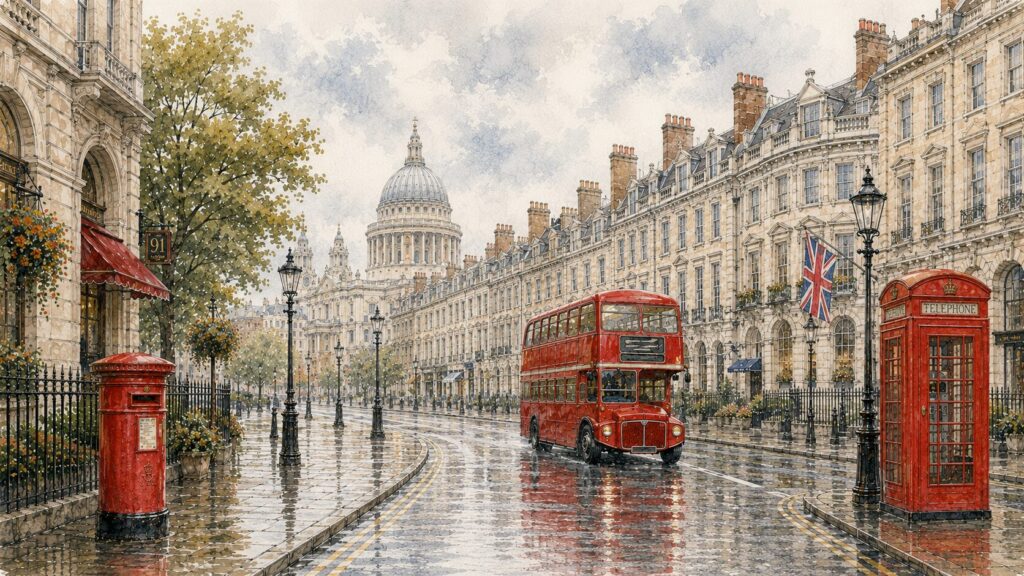
UK landmark coloring pages have a quiet charm.
They are not always bright and colorful at first glance, but that is exactly what makes them beautiful.
Old stone buildings, cloudy skies, narrow streets, black railings, and a small red telephone box can create a scene that feels calm, elegant, and very British.
Still, many people feel unsure when they begin.
Stone walls may look flat.
Too much gray can make the page feel heavy.
A red bus or telephone box may stand out too strongly and look separate from the rest of the picture.
The good news is that you do not need complicated techniques to improve the result.
If you focus on three simple ideas — stone surfaces, mortar lines and edges, and red accents — your UK landmark coloring pages can quickly feel more realistic and atmospheric.
In this guide, we will walk through easy ways to color British stone architecture and use red as a beautiful focal point.
Why UK Landmark Coloring Pages Can Feel Difficult
UK scenes often use a quieter color palette than tropical beaches, flower gardens, or fantasy illustrations.
Many British landmarks are built from stone, brick, slate, or aged materials.
The sky may be soft and cloudy rather than bright blue.
The streets may be filled with gray, brown, beige, black, and muted green.
Because of this, it is easy to think, “I will just color everything gray.” But when every part of the building is colored in the same gray, the scene can lose depth.
Stone architecture depends on small differences: the front of a wall, the side of a column, the inside of a window, the edge of a roof, and the space between each stone block.
The difficulty is not that UK scenes have no color.
The real challenge is that the texture and light changes are more important.
When you understand that, the page becomes much easier to approach.
A small change in shadow can make a wall look solid.
A thin highlight can suggest rough stone.
A red telephone box placed against a calm gray building can make the whole page feel alive.
Three Elements That Create a British Look
To make a UK coloring page feel more natural, focus on three main elements.
The first is the light and shadow on stone architecture.
Try not to see a building as one flat wall.
Instead, look for smaller surfaces: the front wall, side wall, columns, steps, window frames, arches, and roof edges.
Areas facing the light should stay lighter.
Areas tucked inside or facing away from the light can be darker.
The second element is mortar lines and edges.
Mortar lines are the spaces between stones or bricks.
You do not need to draw every line heavily.
In many cases, leaving a thin pale line between stone blocks looks more natural than outlining everything in dark gray.
Edges, such as corners and window interiors, can be slightly stronger to give the building structure.
The third element is a red accent.
A red telephone box, double-decker bus, post box, or small sign can become the visual focus of the page.
Red works beautifully in UK scenes because the surrounding colors are often calm and muted.
A little red can do a lot.
British atmosphere often comes from quiet contrast, not from using many bright colors.
A gray stone street with one red detail can feel more powerful than a page filled with strong colors everywhere.
How to Color Stone Architecture Without Making It Flat
When coloring stone buildings, avoid starting with a dark gray pencil.
Once the whole wall becomes dark, it is difficult to bring back light.
A better approach is to think in three levels: light, middle, and dark.
Begin with a pale gray, warm gray, or beige-gray.
Color lightly and leave some of the paper showing through.
This remaining white can work as natural light on the stone surface.
It can also suggest the rough texture of old stone.
Next, add a middle gray to the shadow areas.
These might include the side of a building, the underside of an arch, the area under a window ledge, or the inside of a doorway.
Try to place this color only where shadows would naturally fall.
Finally, use a darker gray only in small areas.
Add it to deep window spaces, roof undersides, cracks, corners, and the darkest parts of stone joints.
A little dark value can make the building feel solid, but too much can make the whole page look heavy.
It also helps to choose between cool gray and warm gray.
Cool gray can feel like cloudy weather or old city stone.
Warm gray, beige, or light brown can make the building feel aged and welcoming.
You can even combine both: a cool gray shadow with a warm gray base often gives stone a more natural look.
Using Mortar Lines and Edges for Depth
Mortar lines can make or break the look of stone architecture.
If every line is drawn with the same dark pressure, the building may look stiff or cartoon-like.
Instead, try to “save” some mortar lines while coloring.
For example, when you color a stone block, leave a thin pale space beside it.
This pale line becomes the mortar.
After that, you can lightly shade only some parts of the line, especially in shadow areas.
This creates a softer and more natural stone effect.
Edges are just as important.
Corners of buildings, the inside of windows, door frames, and the lower side of ledges can be slightly sharper and darker.
These are the places where the viewer’s eye understands the shape of the building.
A helpful rule is this: keep large wall areas soft, and make important edges firm.
If everything is soft, the building may look blurry.
If everything is hard, the page may look too heavy.
The balance between soft stone surfaces and clear edges gives the scene depth.
Adding an Aged British Atmosphere
Many UK landmarks look beautiful because they feel old, weathered, and full of history.
You can suggest this without making the page look dirty.
Add a few light vertical strokes under windows to suggest rain marks.
Place a little gray-brown near the bottom of stone walls to show age and dampness.
Add small uneven marks to selected stones instead of covering the entire wall with texture.
Cloudy weather is also useful for UK scenes.
You do not need strong black shadows.
Softer blue-gray, violet-gray, or warm gray shadows often feel more believable.
The goal is not to make the building look bright and shiny, but to give it quiet depth.
If the wall looks too clean, add tiny color changes.
One stone can be slightly beige.
Another can be a little cooler.
A corner can be darker.
These small differences create the feeling of real stone without requiring advanced skills.
How to Use Red Accents Beautifully
Red is one of the most enjoyable parts of UK landmark coloring pages.
Telephone boxes, double-decker buses, and post boxes are instantly recognizable and can make the page feel British at once.
However, red is powerful.
If you color it too early or too strongly, it may overpower the rest of the page.
It is often easier to color the stone, sky, and street first.
Then add the red accent near the end, when you can see how bright it needs to be.
Red also needs light and shadow.
Use a bright red or slightly orange-red for the light side.
Use a classic red for the main area.
For shadows, try deep red, burgundy, red-brown, or a small touch of purple.
Avoid using plain black over red unless you want a very dramatic effect, because black can make red look muddy.
On a telephone box, keep tiny highlights along the edges or window frames.
On a bus, darken the lower part, the wheel area, and the shadow under the windows.
These small details help the red object feel like it belongs in the scene.
If the red looks too separate, add a tiny amount of warm color nearby.
A little red-brown in the pavement shadow or a warm reflection on a nearby wall can help connect the accent to the rest of the page.
Practice: Color a Small UK Scene in Six Steps
Here is an easy process for coloring a small scene with a stone wall and a red telephone box.
Step 1: Observe the Scene
Before coloring, look at the whole page.
Where is the main building? Where is the sky? Where is the red object? Decide what you want the viewer to notice first.
If the telephone box is the main focus, keep the surrounding colors calmer.
Step 2: Add a Light Base Layer
Use pale gray, beige-gray, or light warm gray for the stone.
Use a very soft blue-gray for the sky if needed.
Keep your pressure light so you can add more layers later.
Step 3: Decide the Shadow Direction
Choose one light direction, such as the upper left.
Then shade the opposite sides: the right side of columns, the underside of ledges, the inside of windows, and the lower parts of stone blocks.
Step 4: Add Stone Texture
Use short strokes, dots, or small uneven marks on selected areas.
Do not texture every stone in the same way.
A few marks in the right places are enough to suggest age and roughness.
Step 5: Add the Red Accent
Color the telephone box, bus, or post box with red.
Keep the light side brighter and deepen the shadow side with burgundy or red-brown.
Leave small highlights if possible.
※What is an accent color? You can review it here.
Step 6: Bring the Whole Page Together
Look at the page from a little distance.
If the red feels too strong, deepen nearby shadows or add a small warm tone around it.
If the building feels flat, add a few darker edges near windows and corners.
Try One Free Printable First
UK landmark coloring is easier to understand once you try it on paper.
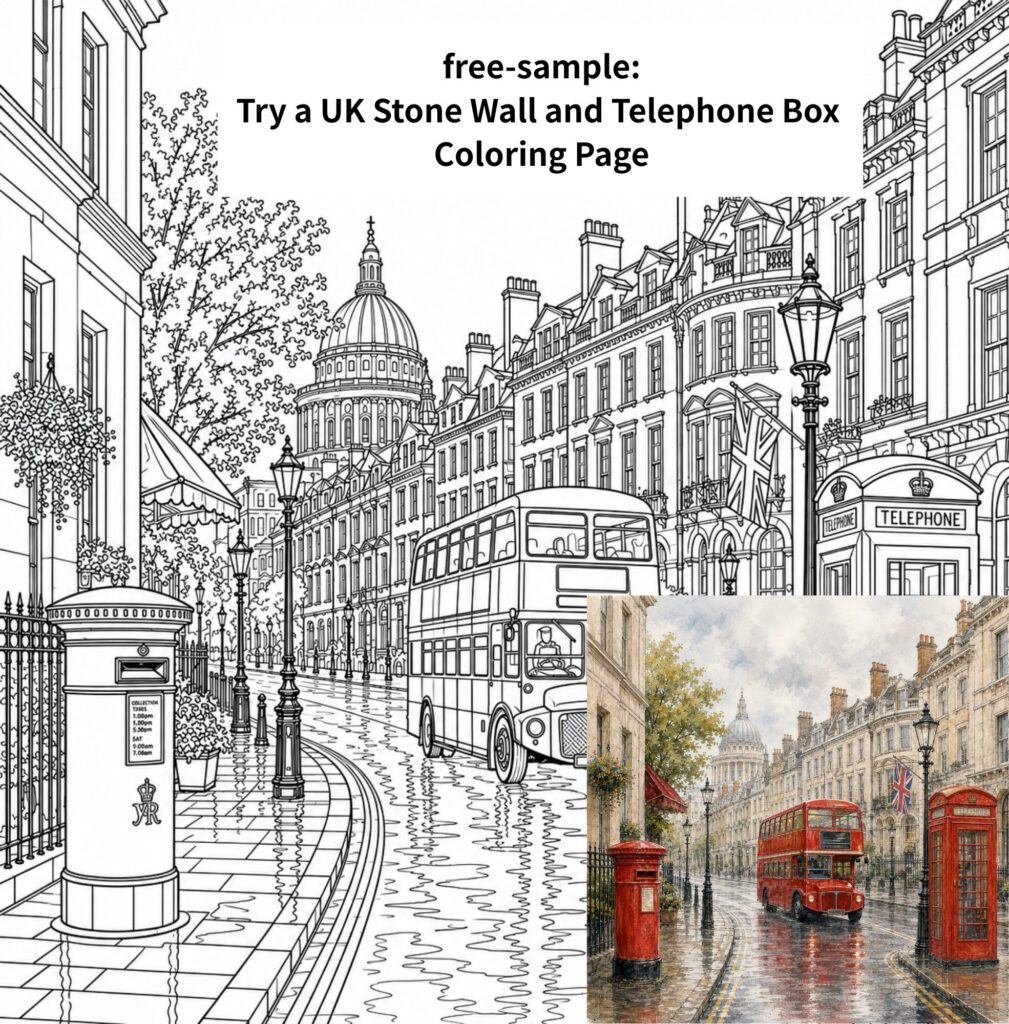
A simple practice page with a stone wall, a window, and a red telephone box is enough to test the three key ideas: stone surfaces, mortar lines, and red accents.
Regular copy paper is fine for a quick test.
If you want to layer colored pencils, slightly thicker paper will feel better.
After printing, let the ink dry before coloring to avoid smudging.
Your first goal does not need to be a perfect finished artwork.
Try using three grays and one red accent.
Notice where the stone starts to look more dimensional and where the red feels balanced.
Free Sample: Try a UK Stone Wall and Telephone Box Coloring Page
This can also be a fun family activity.
Print the same page for two people and compare how different the scene feels when the red is brighter, darker, warmer, or softer.
Common Mistakes and Easy Fixes
My gray stone looks like plain cement
Try adding warm gray, beige, or a tiny amount of brown.
Pure gray can feel flat and cold.
A warm undertone often makes old stone look more natural.
The red telephone box looks too bright
Deepen the shadow side with burgundy or red-brown.
You can also add a small warm color nearby, such as a reddish shadow on the ground, to make the red feel connected to the scene.
The mortar lines look too strong
Do not darken every line.
Keep some mortar lines pale and only shade the parts that sit in shadow.
This makes the stonework softer and more realistic.
The building looks too cartoon-like
Avoid outlining every edge with the same pressure.
Strengthen only important edges, such as corners, window interiors, and deep shadows.
Keep large stone surfaces softer.
Where to Go Next: More World Landmark Coloring Ideas
Once you understand stone surfaces, mortar lines, and accent colors, you can use the same thinking for many other European landmarks.
French stone streets, Italian old towns, German castles, and historic bridges all use similar ideas.
The accent color may change from country to country.
In the UK, red is often the star.
In another scene, it might be a blue roof, green shutters, warm yellow walls, or flowers in a window box.
Looking for these small color signatures makes world landmark coloring more enjoyable.
If you want a broader guide to coloring famous places around the world, start with the pillar article below.
Related Article: A Beginner’s Guide to World Landmark Coloring Pages
If you want to review basic supplies and beginner techniques first, this guide may also help.
Related Article: Basic Coloring Techniques and Supplies for Beginners
Books and PDFs for Enjoying UK Scenes More Slowly
UK scenes are especially enjoyable when you take your time.
Once you learn how to color stone, you may want to try churches, bridges, clock towers, old streets, and quiet corners with cafés or lamps.
A printed book is a good choice if you like to relax with one page at a time.
A digital PDF is useful if you want to print the same design more than once and test different color palettes.
The same telephone box scene can feel cheerful with bright red, nostalgic with deep burgundy, or soft and rainy with muted grays.
If you enjoyed practicing with a free page, a book or printable collection can be a natural next step.
You do not need to rush.
Start with one page, notice what you enjoyed, and continue from there.
Related Product: View UK Landmark Coloring Book
Related Page: Explore the World Landmarks Coloring Series
Conclusion
UK landmark coloring pages are not about using many bright colors.
Their charm often comes from quiet stone textures, soft cloudy light, and one memorable red accent.
When you feel unsure, return to three simple ideas: stone surfaces, mortar lines and edges, and red accents.
Use light, middle, and dark grays to shape the building.
Leave some pale mortar lines instead of drawing every line strongly.
Add red near the end and give it its own highlights and shadows.
You do not need to make the first page perfect.
Each time you color a stone wall, a window, or a telephone box, you will start to see how small choices change the atmosphere.
Enjoy the process slowly, as if you were walking through a quiet British street with colored pencils in your hand.