
When you tell yourself, “I will color when I have more time,” that quiet moment often never arrives.
The day gets filled with work, errands, family, messages, and small tasks that somehow take more energy than expected.
By the time evening comes, it can feel easier to scroll on your phone than to take out a coloring page.
That is why a 10-minute adult coloring routine can be so helpful.
It does not ask you to finish a full page.
It does not ask you to be artistic or perfectly calm.
It simply gives you a small, clear place to begin.
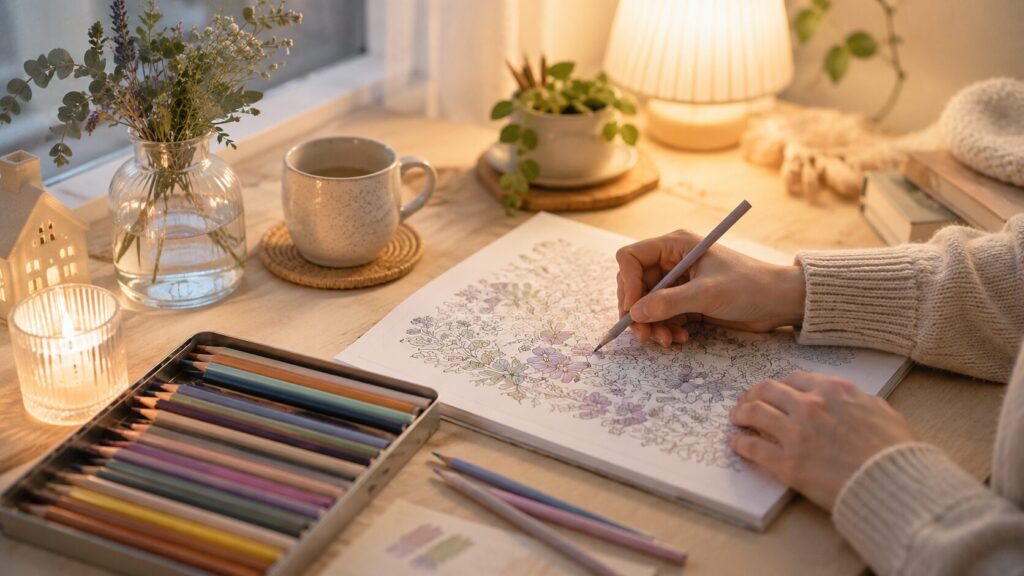
For 10 minutes, you choose a few colors, move your hand slowly, and bring your attention back to the paper in front of you.
In this guide, you will find a simple morning routine, an evening routine, practical tips for staying focused, and a 7-day tracker to help you make coloring a gentle part of your week.
Why 10 Minutes Is Enough to Start Adult Coloring
Adult coloring can feel relaxing, but it can also feel surprisingly hard to start when you are busy.
If you imagine that you need 30 minutes, a clean desk, perfect lighting, and a full set of colored pencils, the activity may begin to feel like one more task on your list.
A 10-minute routine changes that.
Ten minutes is small enough to fit into real life.
You might color before your first cup of coffee, during a quiet lunch break, while the washing machine is running, or before bed instead of opening another app.
The goal is not to complete a beautiful page in one sitting.
The goal is to create a small pause that is easy to return to.
You can color one leaf today, a small part of the background tomorrow, and a window or flower petal the next day.
Each small section counts.
Adult coloring becomes easier to continue when you stop measuring the activity only by the finished page.
The simple act of choosing a color and filling a shape can help you shift your attention away from the noise of the day.
It gives your hands something slow and concrete to do.
You do not have to force yourself to feel calm.
You only need to begin with one small area and let the routine do its quiet work.
If you would like to understand the broader benefits and appeal of adult coloring, this pillar article is a helpful place to start.
Related Article: The Benefits and Joy of Adult Coloring
What to Prepare Before You Begin
A 10-minute routine works best when the setup is simple.
If you spend too much time preparing, you may lose the gentle energy that made you want to color in the first place.
You only need a few things:
- One coloring page
- Three colored pencils
- A timer
- A small piece of paper for testing colors
- A little clear space on your desk or table
Three colored pencils are enough.
In fact, limiting your colors can make the routine easier.
Too many choices can create hesitation, especially when you only have 10 minutes.
For a morning routine, you might choose soft yellow, pale green, and sky blue.
For an evening routine, you might choose dusty blue, lavender, and warm gray.
A timer is useful because it gives the routine a clear beginning and ending.
You can use your phone, but place it face down or turn off notifications before you begin.
The goal is to keep the phone from pulling your attention away from the page.
Choose a design that is not too detailed at first.
Large backgrounds, leaves, flower petals, windows, simple patterns, and open shapes are all good choices.
Instead of saying, “I will color this whole page,” try saying, “I will color this one leaf” or “I will add a soft layer to this small section.”
If you are still choosing your basic supplies, this guide can help you prepare without buying too much at once.
Related Article: Beginner’s Guide to Colored Pencils, Paper, and Basic Coloring Supplies
Morning 10-Minute Coloring Routine
Morning coloring is not about forcing yourself to feel energetic.
Think of it as a gentle way to arrive in the day.
Even if your morning is busy, 10 minutes can give you a quiet starting point.
0:00–1:00 minute|Settle into your seat
Place your coloring page and three pencils on the table.
Sit comfortably, relax your shoulders, and position the paper where your hand can move easily.
You do not need a special posture.
You only need a small space that feels easy to use.
This first minute is for arriving.
Look at the page, touch the pencils, and let your attention move from the rest of the morning to the paper in front of you.
1:00–2:00 minute|Choose only three colors
Choose three colors and begin.
Try not to search for the perfect combination.
The more you compare colors, the faster the 10 minutes will disappear.
For a sky, you might choose light blue, soft gray, and white.
For flowers, you might choose pale pink, gentle orange, and fresh green.
For a simple landscape, you might choose green, beige, and blue.
The best colors are the ones that help you begin without overthinking.
2:00–6:00 minute|Add a light base layer
Use the next four minutes to color a wider area lightly.
Choose a shape that is easy to fill, such as a background, a large leaf, a simple flower petal, or a section of sky.
Keep your pencil pressure soft.
You do not need to make the color rich right away.
A light layer is easier to adjust and less tiring for your hand.
In the morning, rhythm matters more than detail.
Let the pencil move slowly and evenly.
6:00–9:00 minute|Add a little shadow or accent
Use the next three minutes to add a small amount of depth.
You might darken the base of a leaf, the edge of a petal, the lower side of a window, or one corner of a building.
This does not need to be dramatic.
A slightly deeper layer in one small place can make the page feel more alive.
The purpose is to notice one detail and give it a little attention.
9:00–10:00 minute|Write one small note
For the final minute, pause and write one short note.
It could be “I colored one leaf,” “The blue felt peaceful,” or “I sat down for 10 minutes.”
This note is not a judgment of your skill.
It is a record that you showed up.
Small records make it easier to return the next day.
Evening 10-Minute Coloring Routine
Evening coloring works well as a gentle replacement for a small part of your screen time.
You do not have to stop using your phone completely.
Start by replacing only 10 minutes with paper, pencils, and a slower rhythm.
0:00–1:00 minute|Turn off notifications
Before you begin, turn off notifications or place your phone out of reach.
This first minute is a simple boundary between the day and your coloring time.
In the evening, it can help to reduce incoming information.
Soft music is fine if it feels calming, but try not to watch videos while coloring.
For these 10 minutes, let the page be the main focus.
1:00–2:00 minute|Choose a small motif
Choose a small area that can be paused easily.
A flower center, a single leaf, part of a mandala, a row of bricks, a small window, or a simple pattern works well.
It is helpful to decide your stopping point before you begin.
For example, “I will color this one flower center,” or “I will finish this small row.” This keeps the routine from turning into a late-night project.
2:00–6:00 minute|Use similar colors slowly
Evening coloring often feels easier with colors from the same family.
You might use navy, pale blue, and gray.
Or lavender, dusty pink, and light brown.
Similar colors can create a softer look without much planning.
Use light pressure and slow movements.
You are not trying to create a perfect blend.
You are simply giving your hands a calm, repeated motion.
6:00–9:00 minute|Soften with white or a pale color
For the next three minutes, use white, light gray, cream, or a pale pencil to soften the area.
You do not need to cover everything.
A few gentle strokes can make the colors feel more connected.
This step is optional, but many beginners find it satisfying because it gives the section a finished feeling without requiring complex technique.
9:00–10:00 minute|Put everything away
When the timer reaches the final minute, close the page and put your pencils away.
If you want to take a photo, consider doing it the next morning.
Writing captions or checking social media can wake your mind up again.
Evening coloring is not about showing your progress.
It is about closing the day with one small, quiet action for yourself.
Five Tips to Stay Focused
Ten minutes is short, but it can still disappear quickly if your attention is pulled in many directions.
These five tips can help you make the most of the routine.
1. Use only three colors
A large set of colored pencils can be inspiring, but it can also make decisions harder.
For a 10-minute routine, three colors are enough.
You can always add more later, but starting small helps you begin faster.
If you often feel unsure about color combinations, this guide explains simple ways to choose colors for a more harmonious result.
Related Article: How to Choose Beautiful Colors for Coloring Pages
2. Choose one area before you start
Looking at a full page can feel overwhelming.
Before starting the timer, choose one small section.
It could be one leaf, three petals, a part of the sky, or a single window.
A clear starting point reduces hesitation.
It also gives you a small sense of completion, even if the page is far from finished.
3. Keep your pencil pressure light
Pressing hard can tire your hand and make the color difficult to adjust.
Light layers are more forgiving.
They let you build color slowly and stop at any point.
If the color looks too pale at first, that is fine.
You can add another layer tomorrow.
A soft first layer is often the best beginning.
4. Use a timer
A timer helps you relax into the routine because you do not have to keep checking the clock.
Set it for 10 minutes and allow yourself to color until it rings.
When the timer ends, stop even if the section is unfinished.
Stopping while you still want to continue can make it easier to return next time.
5. Value the habit more than the result
Adult coloring is not only about finished artwork.
Sitting down for 10 minutes matters.
Choosing three colors matters.
Putting your phone aside matters.
Returning after a few missed days matters.
Some days your colors may not look the way you imagined.
Some days you may only color a tiny shape.
That is still part of the practice.
A routine becomes sustainable when it has room for imperfect days.
A 7-Day Coloring Tracker to Keep Going
The easiest routines are not built on motivation alone.
Motivation changes from day to day.
A simple tracker can help because it makes your progress visible without adding pressure.
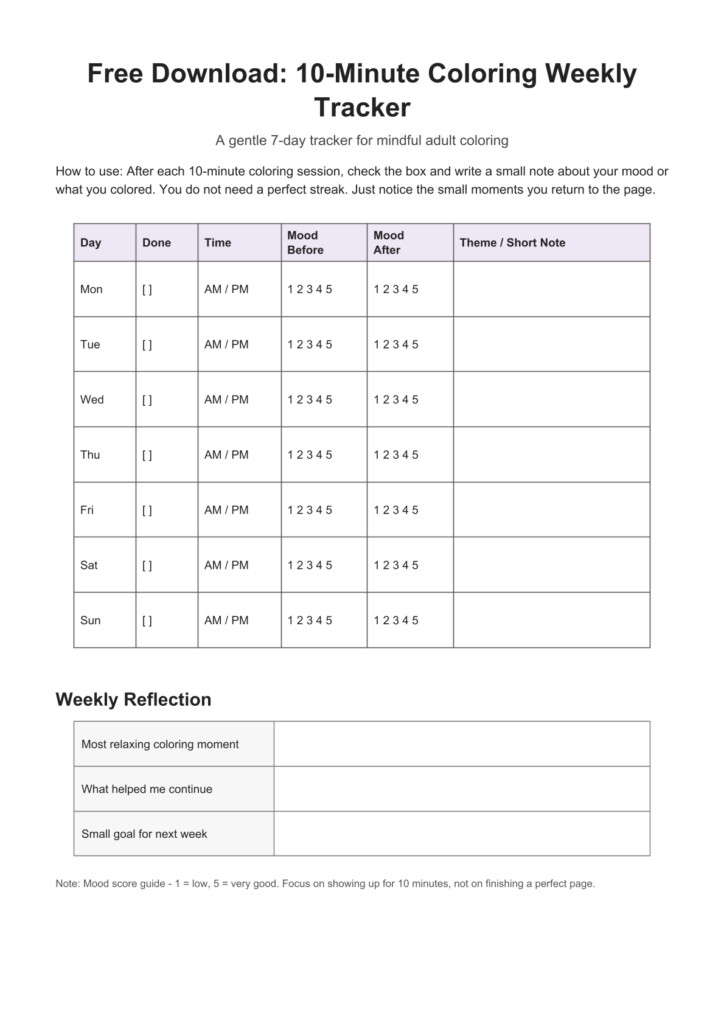
Use a weekly tracker with two small checkboxes for each day: morning 10 minutes and evening 10 minutes.
You do not need to check every box.
Two or three coloring sessions in a week can still be meaningful, especially if you are returning after a busy season.
The point is not to prove that you were perfect.
The point is to make it easy to begin again.
If you miss Monday, return on Tuesday.
If you miss three days, color for 10 minutes on the weekend.
That still counts.
Free Download: 10-Minute Coloring Weekly Tracker
This simple printable PDF lets you track your morning and evening coloring sessions for one week.
Print it and keep it near your desk, coloring basket, or bedside table.
- Format: PDF
- Recommended print size: A4, actual size
- How to use: Check the box on the days you color
- Use: Personal use only.
Redistribution and resale are not allowed.
If you want to try this routine for one week, download the tracker and start with just one 10-minute session.
Frequently Asked Questions
Q1. Is 10 minutes too short?
No.
Ten minutes is enough to begin.
In fact, stopping while you still want to continue can make the routine easier to repeat.
At first, focus on creating a rhythm rather than finishing a page.
Q2. Is morning or evening better?
If you are unsure, evening may be easier because you can replace 10 minutes of phone time with coloring.
If your mornings are calmer, morning coloring can also work well as a gentle warm-up for the day.
Q3. What colors should I choose?
Start with three colors.
For morning, try lighter and fresher colors.
For evening, try softer, muted colors.
If you feel unsure, choose three pencils from the same color family.
Q4. Is it okay to stop in the middle of a page?
Yes.
Adult coloring does not need to be completed in one sitting.
You can color one leaf today, a background section tomorrow, and a small pattern later in the week.
Q5. What if coloring badly makes me feel frustrated?
Choose simpler designs with thicker lines and larger spaces.
Also, try to evaluate the action rather than the result.
“I sat down for 10 minutes” is a success.
“I chose three colors” is a success.
The page does not need to be perfect.
Related Articles and Helpful Next Steps
Once the 10-minute routine feels comfortable, you may want to explore supplies, color selection, or printable pages that fit short sessions.
Related Article: Free Coloring Samples
If you want to start right away, a printable mandala PDF from Gumroad can be a convenient choice.
You can print only the pages you need and use them for morning or evening 10-minute sessions.
View the Mandala Printable PDF on Gumroad
If you prefer the feeling of a physical book, you may enjoy a printed coloring book from Amazon.
Turning the pages and keeping the book by your bedside can make the routine feel more natural.
View Mystical Mandala on Amazon
Conclusion
Adult coloring does not have to take a long time.
For a busy person, a small 10-minute routine may be easier to keep than a big plan that rarely happens.
In the morning, you can color a wide area lightly and begin the day with a calmer rhythm.
In the evening, you can replace a small part of screen time with paper and pencils, creating a gentle way to close the day.
In both cases, the goal is not perfect artwork.
The goal is to make a quiet space for yourself.
Choose three colors.
Pick one small area.
Set a timer for 10 minutes.
When the timer ends, stop without judging the result.
If you miss a day, simply return when you can.
Start today with one leaf, one flower petal, one small piece of sky, or one simple pattern.
A little color on the page can become a small reminder that even on a full day, there is room for a quiet moment of your own.