
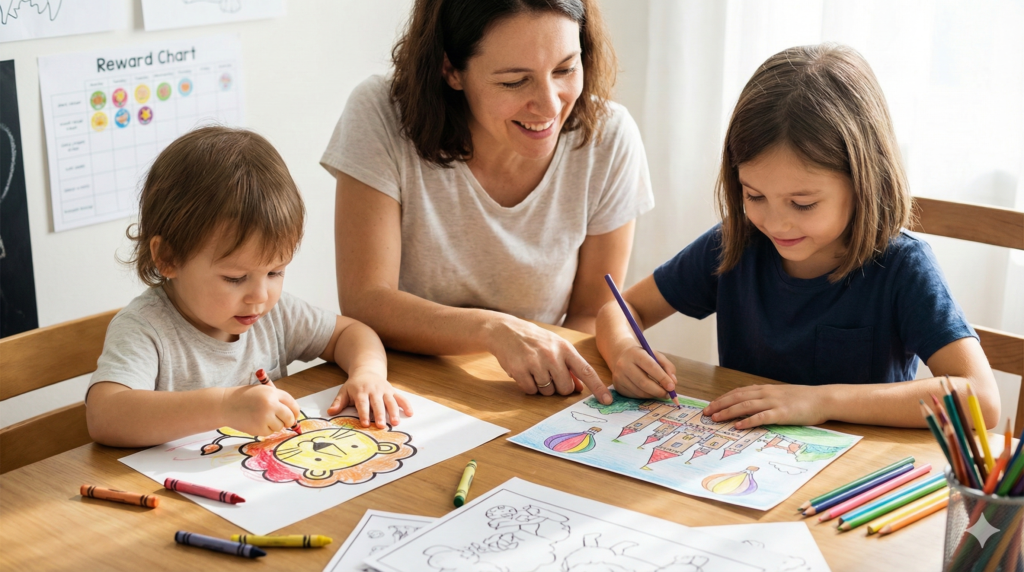
“I don’t know which coloring pages fit my child.”
“They can’t stay focused.”
“I keep messing up the print settings.”
—Yep, classic parent struggles.
But I’ll say it upfront:
When coloring doesn’t stick, it’s not your child’s personality—it’s a difficulty mismatch.
Give a 3–6-year-old a page with tiny details, and it feels tiring before it feels fun.
Give a 7–10-year-old a page with only big open areas, and it feels unsatisfying.
In this article, I break down how to create the “just-right” difficulty level using two age groups—ages 3–6 and ages 7–10—in a clear, step-by-step system. You’ll also get practical, ready-to-use tips for printing at home (paper, settings, ink-saving) and a simple framework to turn family coloring time into a habit—starting today.
And with the free sample download at the end of the article, you can start your “family creativity time” as early as tonight.
Table of Contents (Jump to Any Section)
- Child Development by Age & the Benefits of Coloring
- Motifs & Difficulty Design: Set it up to work well for each age
- Home Printing Tips: Paper, ink-saving, resizing
- A System That Keeps Family Coloring Going
- Free Downloads & Examples: Start Today in 3 Steps
- Safety & Copyright Basics
- FAQ
- Summary: Family coloring isn’t about talent—it’s about design.
Child Development by Age & the Benefits of Coloring
Ages 3–6: Build confidence by starting with “It’s OK to color outside the lines.”
For children ages 3–6, the goal of coloring isn’t to “color neatly” right away.
The real aim is to move their hands and stack up small “I did it!” moments.
- Fine motor skills (developing small hand muscles)
- Color and shape recognition (“This is red,” “This is a circle”)
- A sense of achievement → self-esteem (the first芽 of confidence)
Recommended motifs
Choose themes that connect easily to everyday words, such as animals, vehicles, and food.
How long is best?
Stopping before they get bored makes them look forward to the next time.
A tip for parents
Instead of saying, “You’re coloring outside the lines,” try:
“Wow—look how many colors you’ve added!”
Ages 7–10: A time when observation skills grow—give them “room to experiment.”
By ages 7–10, kids make big gains in observation skills, attention control, and planning.
At this stage, coloring can easily connect to learning and skill-building, too.
- Slightly thinner lines
- Parts divided into a moderate number of sections
- Perfect as an introduction to learning “shading,” “texture,” and “color-planning”
Aim for about 10–20 minutes per session, gradually increasing the difficulty little by little.
Motifs that connect to learning—such as world landscapes, historic buildings, and seasonal events—work especially well.
Adding a few English words in the margins can also spark more parent–child conversation (e.g., bridge, castle).
Casual chats like, “Which country do you think this looks like?” often end up being the most memorable.
Motifs & Difficulty Design: Set it up to work well for each age
Here’s where family coloring often goes wrong.
Even with the same “cute design,” the difficulty can be completely different depending on line thickness and how the parts are divided.
For ages 3–6: Bold lines + big shapes (a confidence-friendly design)
As a guideline, aim for outlines around 2.0–3.0 pt. Rounded corners also make it feel more friendly and reassuring.
- Larger coloring areas
- Fewer color changes
- Themes that are easy to keep within a similar color family (e.g., a fruit bowl / close-up animal faces)
The “3-Color Rule” to reduce hesitation
Example: Choose only three colors—red, yellow, and blue (primary colors).
When you limit the number of colors, kids spend less energy on deciding and can focus more on coloring.
For ages 7–10: Thinner lines + divided sections (a design made for creativity)
As a guideline, aim for outlines around 1.0–1.5 pt.
For the sections, keep them divided but not too tiny—if they’re too small, it starts to feel like “work” instead of fun.
- Create areas that let kids add shading in 2–3 levels for things like the sea, sky, and buildings.
- Add small dotted hint marks as guides (like a little “shade here” cue).
- Explaining color choices in three layers—main → secondary → accent—makes it easier to understand.
Once you go this far, it’s no longer just a simple printable activity—it becomes a real finished piece.
Home Printing Settings: Practical Tips to Avoid Printing Problems
Paper Choice: “No bleeding, no show-through” is the top priority.
For a home inkjet printer, thicker matte paper (roughly 135–180 gsm) is easy to use.
- Colored pencils: Drawing paper is fine, too.
- Alcohol markers: Use thicker paper that resists bleed-through, and avoid double-sided use.
If you plan to bind pages in A4, leave 10–12 mm as a binding margin—it’ll make things much easier later.
Ink Saving: For line art, simply using one consistent black makes a difference.
- Keep line art black consistent as K=100% (convert to grayscale).
- Printer settings on “Standard” are enough (no need for “High Quality”).
- For color preview pages, 150 dpi is usually still clear enough to see.
- Instead of printing everything at once, print only what you need—it reduces cost.
Ink disappears before you notice. That’s why it pays to build in ink-saving choices from the start.
Resizing: Printing A4 down to A5 really works—for the right kids.
Printing A4 pages scaled down to A5 can be effective without hurting readability.
- Preschoolers: Larger pages (A4 to Letter) are easier to handle.
- Elementary kids: Some can stay focused better even on A5.
Turn on “Fit to paper” in your printer settings, and try a scale of 90–100% first.
A System That Keeps Family Coloring Going: Motivation comes from structure.
Family coloring is often harder to keep going than it is to start.
The key isn’t motivation—it’s setting up a simple system that removes decision-making.
Weekly Themes: Don’t think about what to color next.
例:
- Week 1: Animals
- Week 2: Seasons
- Week 3: Vehicles
- Week 4: Cities Around the World
Rewards don’t have to be “things.”
Experience rewards are powerful too—like going to a museum together or browsing an art supply store as a family.
Reward Sheet: When progress is visible, kids start motivating themselves.
- Finish 2 pages in a week → 1 stamp
- Collect 5 stamps → a reward download (special coloring page)
Rewards don’t have to be “things.”
Experience rewards are powerful too—like going to a museum together or browsing an art supply store as a family.
Free Downloads & Examples: Start Today in 3 Steps
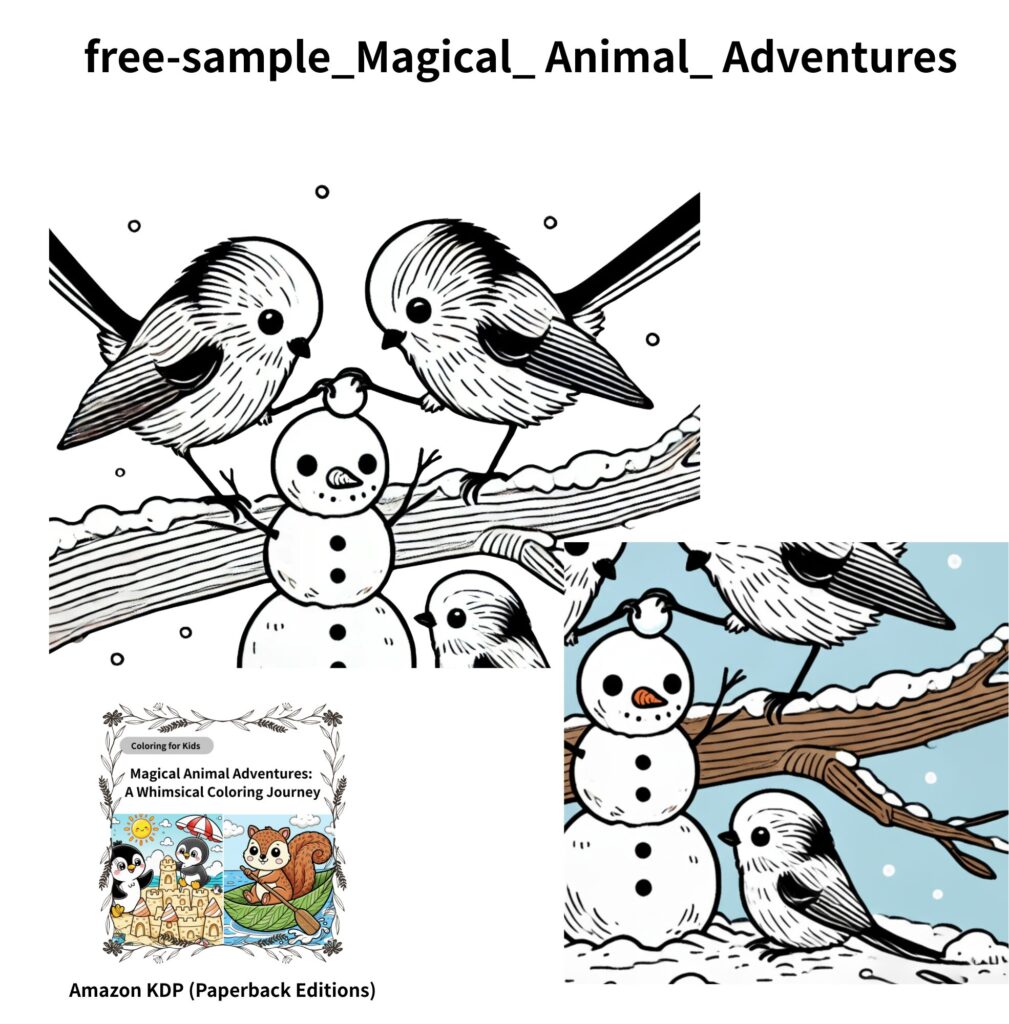
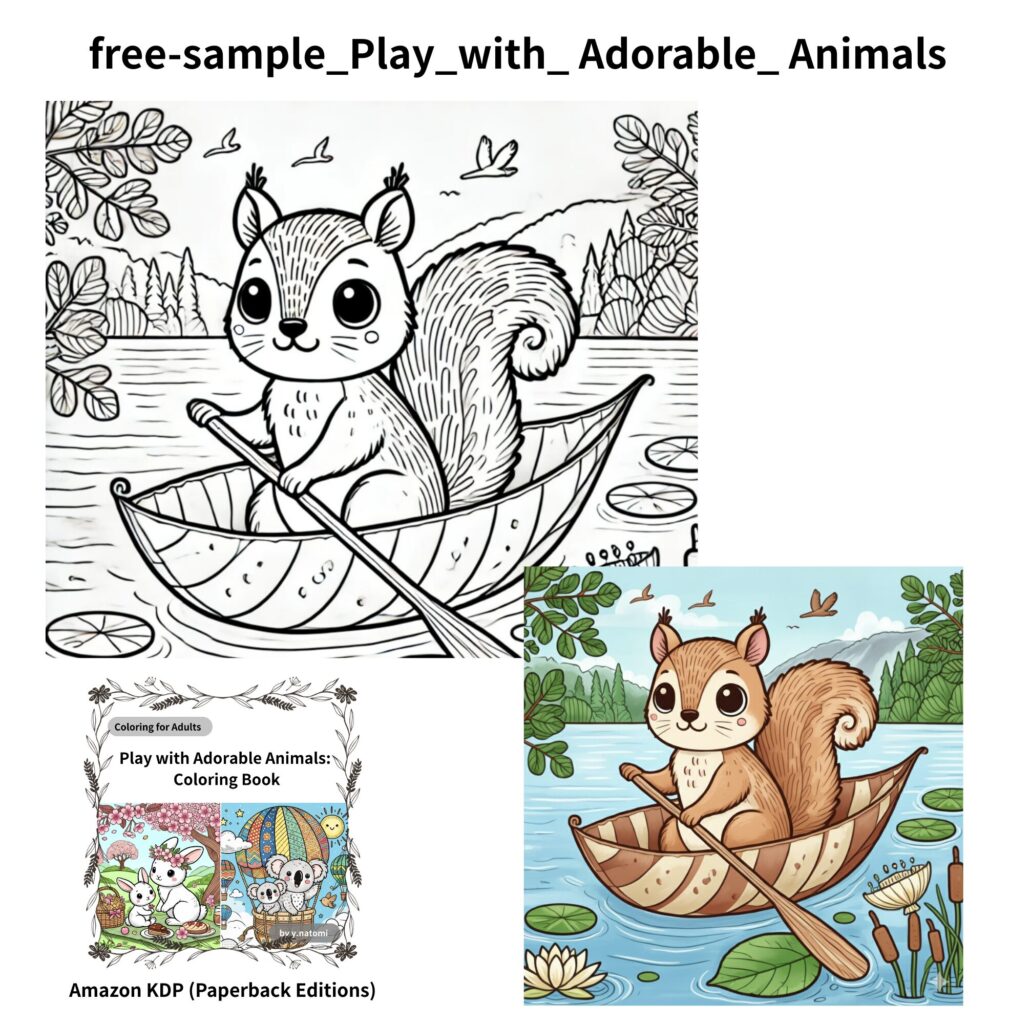
I prepared one sample page for each age group.
Please feel free to print and use them for personal, non-commercial use within your household.
【Free Download Box】
- Download: Get the age-based sample PDF from the link at the end of this article.
- Print: Print on A4 with Margins ON and Standard Quality.
The black-and-white pages are the coloring templates.
The color pages are for inspiration—choose any colors you like! - Use: Take a photo of the finished artwork and save it (posting on social media is optional).
If you’d like, you can use #DreamColoringJourney (optional)
Classroom use and commercial distribution are not allowed.
As parents, the ideal is “a little every day,” but real life gets busy.
That’s why even twice a week is enough.
The best pace is simply the one you can keep going.
Safety & Copyright Basics: Enjoy Coloring Safely at Home
Safety (especially for ages 3–6)
- Watch for choking hazards and sharp points with colored pencils.
- Always clean up after coloring (one crayon or pencil left on the floor can be a surprisingly real hazard).
- Adults should keep and manage anything sharp, such as pencil sharpeners and blades.
Copyright (very important)
The designs and data on this website are copyrighted by Natomi Planning / Dream Coloring Journey.
- Personal, non-commercial use at home (printing and enjoying with your family): OK
- Redistribution / resale / commercial use / public posting or sharing of the files: Not allowed
- Use in schools, classrooms, or workshops: Please check the provider’s guidelines separately.
For Those Who Want to Keep Going
If the free printables made you think, “We might actually be able to keep this going,” the fastest next step is to build an environment that makes it easy to continue.
The easier it is for parents, the more kids grow.
- Gumroad (Printable PDFs): Download printable coloring collections instantly → Browse Dream Coloring Journey PDFs
- Amazon (Family Collection): Prefer a larger print collection for family coloring time? → A Family-Friendly Animal Coloring Book Collection
- Amazon (Family Print Edition): A deluxe parent–child set to enjoy together → (Coming Soon)
— Related Reading —
- Perfect for Ages 3–6! How to Choose Bold-Line, Big-Shape Coloring Pages (Free DL)
- Engaging Detailed Coloring: Ages 7-10 (Free DL)
- Ideas for Using Free Printables: (Coming Soon)
Frequently Asked Questions(FAQ)
Q1. My 3–6-year-old can’t stay focused. What should we do?
A. 5–10 minutes per session is enough. Start with simple large areas to fill in, and don’t worry about finishing—stopping halfway is totally fine.
To build more “success moments,” try a mini palette at first: pick only three colors.
Q2. I’m worried about the cost of paper and ink.
A. For coloring templates, black-and-white line-only printing is enough.
Instead of printing in bulk, print only the pages you need, when you need them.
For paper, choosing a bulk pack of thicker matte paper can lower the cost per sheet.
Q3. When siblings are different ages, the same theme can feel very different in difficulty.
A. Prepare the same motif in two difficulty levels: a bold-line version and a thin-line version.
(Some Amazon paperback coloring books include both versions of the line art.)
If you split roles—preschoolers: larger pages + fewer colors, and elementary kids: thinner lines + shading practice—both can stay satisfied even when coloring at the same time.
Summary: Family coloring isn’t about talent—it’s about design.
One last time—the most important point.
Whether family coloring sticks isn’t determined by your child’s attention span, but by how well you match the difficulty level.
- Ages 3–6: Bold lines, big shapes, fewer colors (5–10 minutes)
- Ages 7–10: Thinner lines, moderate sections, shading + color planning (10–20 minutes)
- Print on Standard Quality and use pick printing (only what you need) to cut costs
- Use weekly themes and a reward sheet to keep going without overthinking
To start, just the two free download pages are enough.
Tonight, try placing one page on the table.
You may be surprised—family time often comes back from there.
▶ Learn More: Free Family Coloring Templates & How-to Guide (Summary) → (Coming Soon)