
Ever feel like you’re “resting” but not actually recovering—
scrolling your phone, yet your mind stays noisy?
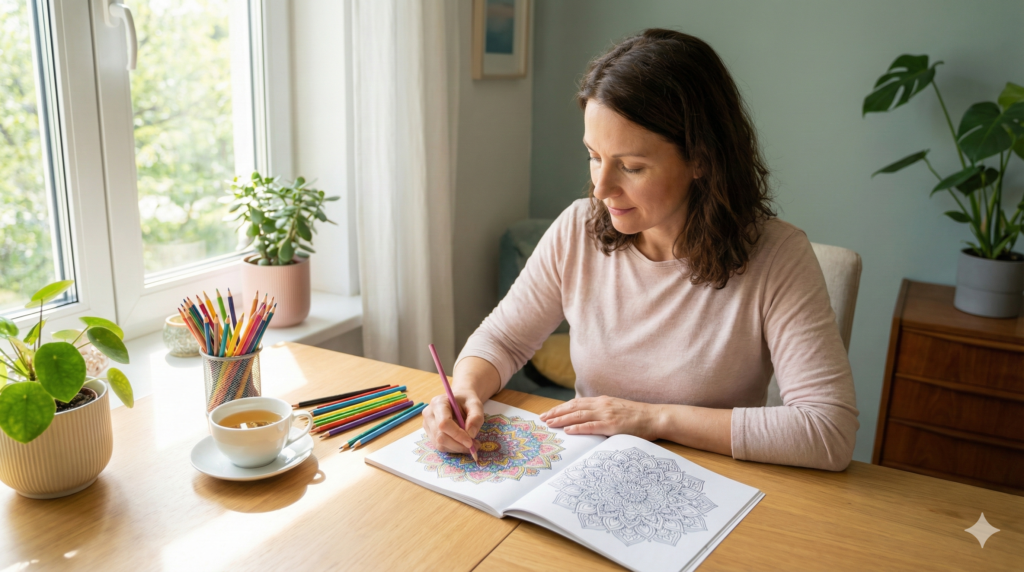
Adult coloring isn’t just a hobby for making pretty pages. It’s a simple, hands-on way to lower mental noise, bring your attention back to the present, and gently stop the overthinking loop—often faster than you’d expect.
In this guide, I’ll break down why adult coloring can support stress relief, focus, and creativity, in a practical (non-fluffy) way. You’ll also find an easy “start in 10 minutes” approach and tips on choosing the right patterns—so you can try one page today.
Table of Contents (Jump to any section)
- Bottom line: Adult coloring is perfect for people like this
- What’s so great about adult coloring?
- Why It Works: 3 Reasons Adult Coloring Feels So Easy
- Does It Really Work? 7 Changes You Can Expect from Adult Coloring
- How to Start Today
- How to Choose a Coloring Page You’ll Stick With
- FAQ
- Recommended Coloring Books
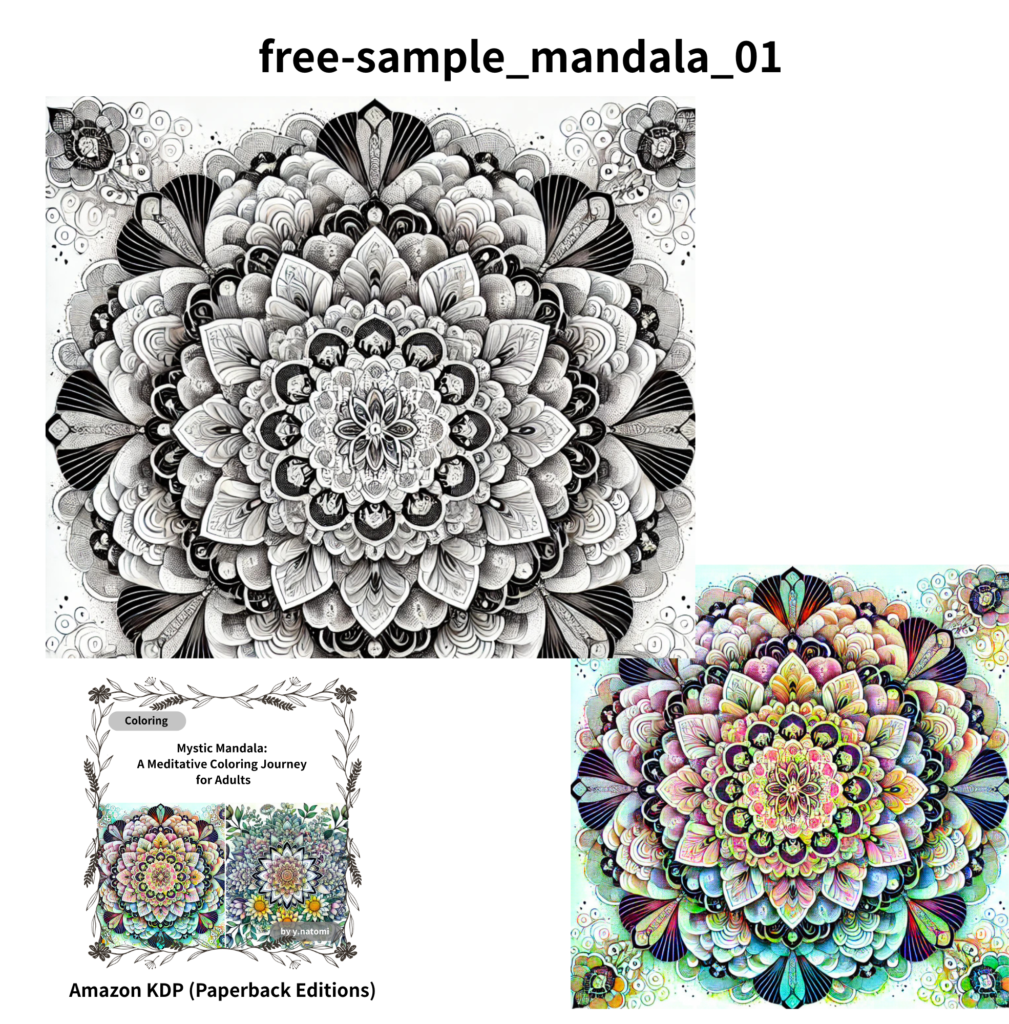
- Try a free 1-page sample
- Summary
Bottom line: Adult coloring is perfect for people like this
“You’re tired, but you’re not good at taking a break.”
“My mind feels restless all the time.”
“I scroll on my phone, but I don’t feel recharged.”
…That’s where coloring comes in.
Adult coloring isn’t just a hobby—
- Move your hands to quiet the noise in your mind.
- Bring your attention back to the present moment.
- Break the overthinking loop.
It does all three—surprisingly easily.
What’s so great about adult coloring?
I don’t see coloring as something you have to “push yourself” to do—it’s a small ritual for recovery.
Here’s the key point.
- Simple rules: just color.
- You can see your progress (the colors build up).
- It’s okay to stop anytime (hard to mess up).
In other words, it’s like “low-barrier meditation” for busy adults.
Why It Works: 3 Reasons Adult Coloring Feels So Easy
1)Your attention narrows to one point (fewer distractions).
Color inside the lines, choose your colors, and move forward little by little.
That alone can stop the “multiple tracks playing at once” in your head.
2)It’s easier to slip into a light “flow state.”
Not too hard, not too easy.
That sweet spot makes it easy to get absorbed.
3)The tactile act of using your hands creates a sense of calm and safety.
Compared to just staring at a screen, watching color fill the paper leaves you with a stronger sense of satisfaction.
(It’s the opposite of “I thought I was resting on my phone, but I feel even more tired.”)
Does It Really Work? 7 Changes You Can Expect from Adult Coloring
From here, I’ll keep it practical—mixing in not just “how it feels,” but also what research and experiments suggest.
Benefit 1: Stress and anxiety can feel lighter.
Adult coloring—especially structured, repetitive designs—has been studied, and some research has observed a reduction in feelings of anxiety.
For example, experimental reports suggest that participants who colored mandalas or regular patterned designs tended to show greater decreases in anxiety than other groups. (CoLab)
There are also reports from a randomized controlled trial involving emergency department patients, showing that the coloring intervention lowered anxiety scores within a short time. (PubMed)
This is important:
It’s not about something dramatic like “changing your life.”
What’s great is a realistic effect—more like “I feel a little better two hours later.”
Benefit 2: Your focus comes back (great as a pre-work warm-up, too).
Coloring is great practice for focusing on one task at a time.
And the more your thoughts feel scattered, the more powerful it can be to simply color inside the lines.
Benefit 3: Creativity increases (ideas come more easily).
Before creativity shows up as a spark of inspiration, what you really need is “mental space.”
- You’re constantly taking in information.
- Constantly making decisions.
- Constantly reacting.
Stop that—and play with color.
Then, the deeper part of your mind starts organizing things on its own.
Benefit 4: A trigger for better sleep quality
Phone before bed → your brain gets stimulated.
Coloring before bed → a quiet cool-down.
This isn’t a guarantee that your sleep will improve—it simply means coloring can be a great fit as a bedtime routine.
Benefit 5: A gentle boost in self-esteem
A finished page may seem small—but it works.
- It stops the thought of “I didn’t do anything today.”
- It creates “I made a little progress.”
Stacking small wins like that can quietly lift your mental baseline.
Benefit 6: A reset for digital fatigue
Step away from the screen’s light and information—and into the world of paper.
For a lot of people, that alone is genuinely restorative.
Benefit 7: More conversations with family and kids (great for parents and children, too)
Parent-child coloring works even with very few words.
More than “good” or “bad,” what stays with you is: “We did it together.”
How to Start Today (30 Minutes Is Enough)
“Isn’t coloring just a hobby for people who have a lot of free time?”
…If you thought that, here’s the fastest way to get started.
Step 0: Here’s all you need.
- Colored pencils (whatever you already have is fine)
- One coloring page (a simple design)
- A timer
Step 1: Color for just 10 minutes (start short).
If you start with 60 minutes, you probably won’t stick with it.
Start with 10 minutes. Stop while it still feels like you could do a little more.
Step 2: Limit yourself to just three colors.
The more colors you have, the more you hesitate.
At the start, three colors are more than enough.
Step 3: Let go of “trying to do it perfectly.”
The goal isn’t the artwork—it’s recovery.
It’s okay if you go outside the lines or the colors look “wrong.”
How to Choose a Coloring Page You’ll Stick With (No-Burnout Tips)
People who keep going don’t rely on just one book from the start.
They choose based on their mood.
On tired days: bold lines + large shapes
→ less decision-making, faster sense of completion
On restless days: structured patterns (mandalas, repeating designs)
→ easier to feel calm (research also suggests this). (CoLab)
On “I want to travel” days: scenery and architecture (world landmarks)
→ more immersion, great for a mental reset
If you’d like to enjoy coloring even more, please check out the next article as well.
- Tools: A Beginner’s Guide to Colored Pencils, Paper, and Essential Supplies
- Color Selection: How to Choose Colors for Beautiful Coloring Results (Color Psychology)
- Recommendations: 10 Best Coloring Books for Adults (By Style) (Coming Soon)
FAQ(Frequently Asked Questions)
Q1:Do I have to do it every day for it to “work”?
A:No—daily isn’t necessary.
Even 2–3 times a week is enough as a simple “reset switch.”
Q2:Do I have to use colored pencils?
A:Okay.
But for beginners, colored pencils are often the easiest because they’re hard to mess up.
Q3:I can’t color well…
A:You don’t need to be “good” at it.
The benefits of coloring come less from coloring perfectly and more from simply moving your hands.
Q4:How long is effective?
A:Start with 10 minutes. Once you get used to it, try 20–30 minutes.
Many studies use interventions of around 20 minutes. (CoLab)
Q5:Does it help with anxiety or depression?
A:It may help you feel a bit better as a supportive tool, but it’s not a substitute for treatment.
If your symptoms feel severe, please consider reaching out to a medical professional or a qualified specialist as an option.
Q6:I’m not sure where to start.
A:When you feel stuck, start with one simple page + a three-color limit.
That first “small win” matters the most.
Recommended Coloring Books (Print Editions)
Start with a print coloring book on Amazon.
- The feel of paper
- Easier to focus
- Great as a gift
View Mystical Mandala on Amazon
View the Mandala PDF on Gumroad
Try a free 1-page sample first to feel it—then choose your coloring book.
Summary: Adult coloring is a habit that quietly resets a tired mind.
One last time—just the key points.
- There are studies suggesting adult coloring may help reduce stress and anxiety. (PubMed)
- The trick isn’t “coloring well,” but keeping it short, choosing quickly, and sticking with it.
- People who keep going switch designs based on their mood.
- From here, guiding readers to “Tools,” “Color,” and “Recommended Books” will boost both SEO and sales.
References / Sources (Research Papers / Studies)
- Curry & Kasser (2005) “Can Coloring Mandalas Reduce Anxiety?” (CoLab)
- Randomized Controlled Trial: Adult Therapeutic Coloring in the ED (2020) (PubMed)
- RCT: Coloring activities in older adults (2020) (PubMed)