
How Coloring Changes Family Time | Benefits for Preschoolers to Elementary School Kids & Recommended Books
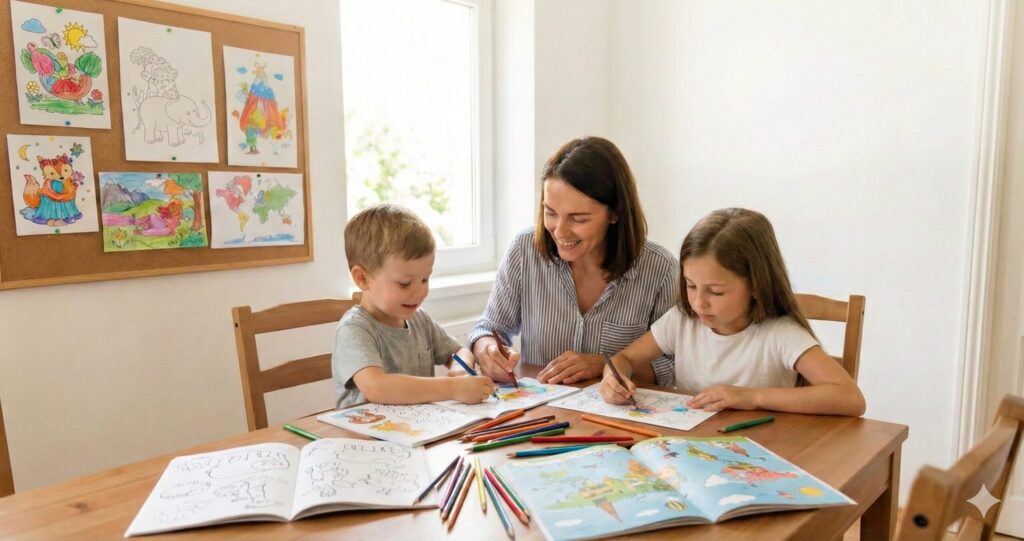
“Watching YouTube all the time.”
“Can’t sit still.”
“Talking less as a family.”
In moments like these, the easiest activity to bring into daily life is coloring.
It requires little preparation and is easy to clean up.
Yet children naturally focus, and parents can stay involved alongside them.
On this page, you’ll find practical tips for sustainable family coloring, age-based selection advice, and recommended parent–child titles from Dream Coloring Journey.
Why Coloring Supports Child Development (Benefits)
1)Fine Motor Skills (Hand Control & Precision)
Coloring within lines builds the foundation for pencil control.
2)Focus & Perseverance
Because there is a visible goal—“Finish one page”—children can stay engaged to the end.
3)Color Sense & Observation Skills
Choosing colors → applying them → noticing differences helps develop perception.
4)Emotional Stability (Calming Time)
Quiet work regulates breathing and works well as a bedtime routine.
By Age: How to Choose & Enjoy
Preschool (Ages 3–5)
- Choose bold lines and large shapes
- Focus less on “coloring well” and more on saying “You did it!”
- Turn it into learning by playing color-naming games (red, blue, yellow)
Early Elementary (Ages 6–8)
- Exciting themes like characters, animals, vehicles, and world landmarks work well
- Use a “3-color rule” (e.g., sky = blue tones, trees = green tones) to reduce confusion
Upper Elementary (Ages 9+)
- More detailed designs and backgrounds increase concentration
- Gradients and shadows add engaging creative challenges
The Most Important Tip: How Parents Speak Matters
If coloring feels too much like “education,” children quickly lose interest.
Keep it simple:
- “Which color will you choose?” (Offer choices)
- “That color looks great.” (Observe, don’t judge)
- “You worked hard on this.” (Praise the process, not just results)
How to Choose (Premium / Standard / Budget Editions)
| Tier | Best For | Features |
|---|---|---|
| Premium (Deluxe Edition) | Families who want a weekend activity or to share among siblings | Larger volume, long-term use |
| Classic (Standard Edition) | Families who want a steady daily habit | Balanced quantity and difficulty |
| Budget (Light Edition) | Families who want to try it first or take it on outings | Casual and easy to start |
Recommended by Dream Coloring Journey (Good–Better–Best Picks)
✅ Premium (Deluxe Edition): A Family Collection to Share
- Large enough that siblings won’t fight over pages.
- ▶ Deluxe Edition List:Recommended Coloring Books (Deluxe Edition)
✅ Classic (Standard Edition): Create a Daily “Quiet Time”
- Perfect for 15 minutes after dinner or before bed.
- ▶ Standard Edition List:Recommended Coloring Books (Standard Edition)
✅ Budget (Light Edition): Try “Coloring Is Fun” First
- Easy to begin and observe your child’s reaction.
- ▶ Light Edition List:Recommended Coloring Books (Light Edition)
How to Make It Stick (3 Simple Steps)
- Start with just 10 minutes (don’t overdo it)
- Complete the cycle: “Choose → Color → Show”
- Display finished pages (fridge, wall, or file)
Simply displaying the work naturally increases a child’s desire to create again.
Frequently Asked Questions (FAQ)
Q. My child colors outside the lines and I get frustrated…
A. That’s normal. Staying inside lines develops over time. At first, focus on increasing “I did it!” moments.
Q. How many colored pencils do we need?
A. Twelve colors are enough to start. Add more when your child’s favorite colors increase.
Summary
Family coloring is play—yet it builds focus, encourages conversation, and gently brings rhythm to daily life.
Start by choosing one book from the Premium / Standard / Budget options that fits your family’s style.
▶ Family Premium (Deluxe Edition):Recommended Coloring Books (Deluxe Edition)
▶ Family Classic (Standard Edition):Recommended Coloring Books (Standard Edition)
▶ Family Budget (Light Edition):Recommended Coloring Books (Light Edition)